
Mixing
Does your tank actually mix?
Mixing design for new brewery tanks and audits of existing ones: how long it takes, what stays unmixed, and what to change.
New tanks
Choose the method, then size it
For a tank at the design stage, before the nozzles are fixed.
- Method selection for the tank and the product
- Head or nozzle, pump and recirculation sizing
- Expected mixing time
Existing tanks
Audit what you already have
For a tank that stratifies, mixes slowly or varies from batch to batch.
- Review of geometry, pump and operating data
- Assessment of the current mixing method
- Effect of repumping
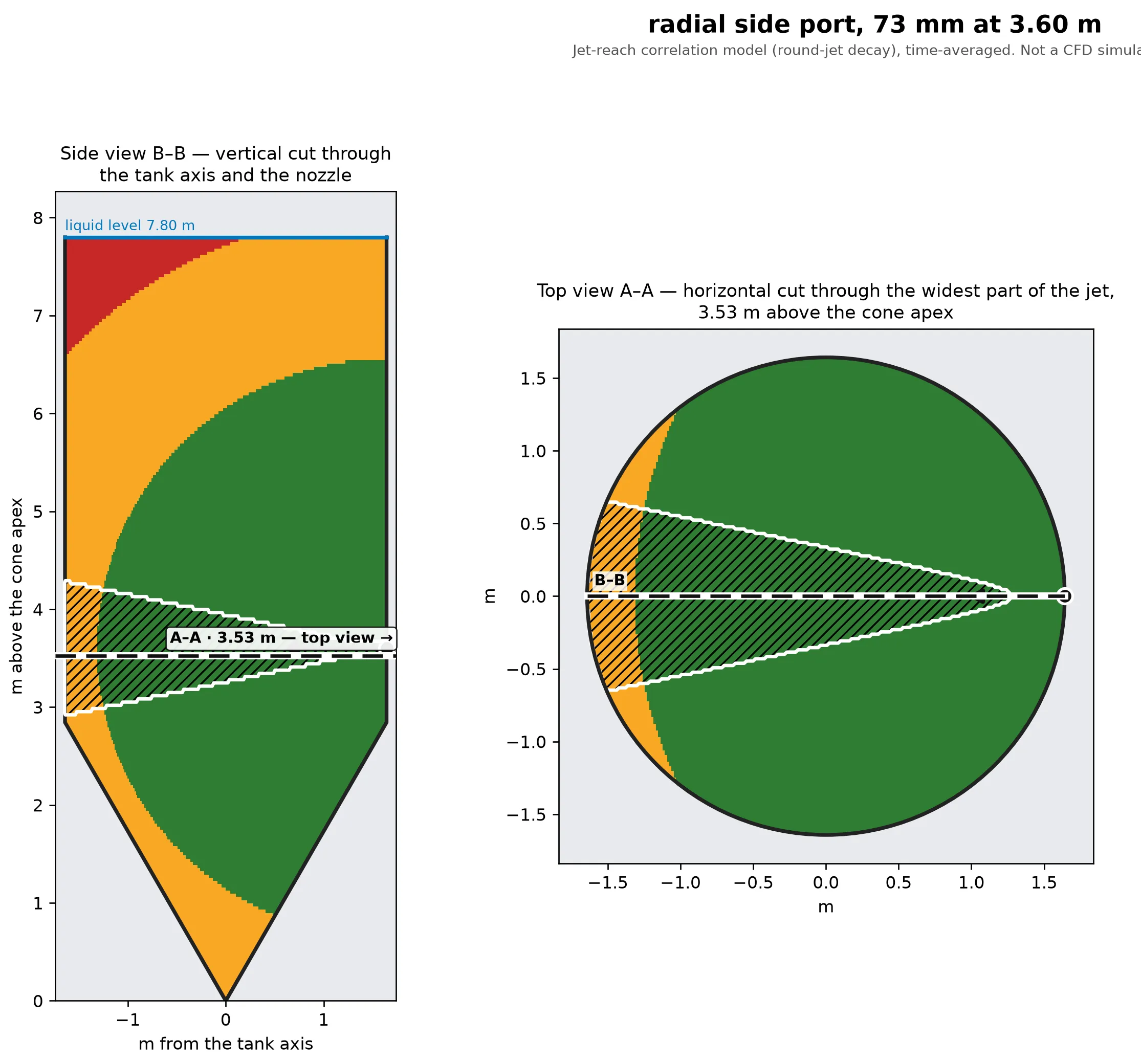
What an audit shows
A 500 hl tank with a 73 mm side-port return at 30 m³/h. Green is reached with margin, amber only just, red blends last. One picture says whether the loop does the job, and the numbers behind it say what to change: flow, bore, height or aim.
Methods
Rotary jet heads
Sized by jet power and turnover for the tank volume.
Recirculation loops
Standing pipe or side port, driven by an external pump.
Cone agitators
Mounted in the cone of cylindroconical tanks and yeast propagators.
Have a tank in question?
Send the tank dimensions and how it is used today.